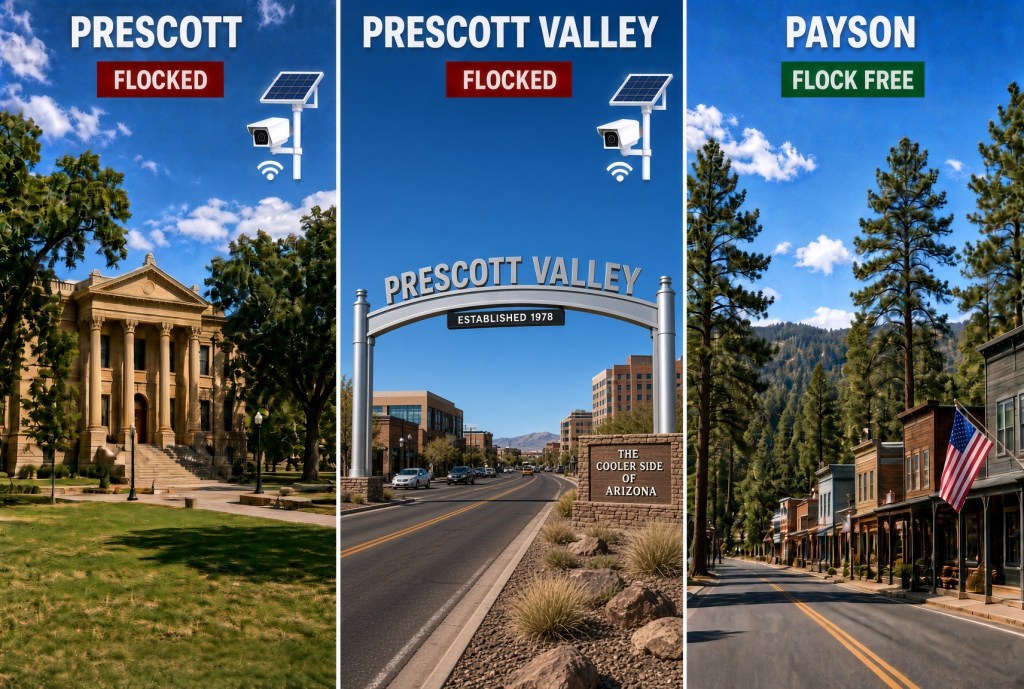
If you live in Prescott or Prescott Valley and the Flock Safety debate has made you start eyeing the exits, there’s a nearby town that looks and feels a lot like home — minus the cameras.
The surveillance math right now
As of late September 2026, Prescott’s police department has around three dozen Flock automated license plate readers documented across the city. Prescott Valley’s system is comparable in scale: as of the town’s most recently updated public technology page (January 2026), the department runs 26 stationary ALPRs and two mobile units, with 16 more stationary cameras planned, plus six LiveView cameras and two planned pan-tilt-zoom units at Mountain Valley Park, tied together through a planned “real-time operations platform.” Neither town has shown any sign of pulling back.
About two hours southeast, a different story
Payson — a Gila County mountain town at roughly the same elevation, in the same ponderosa pine belt — pulled the plug on its Flock contract on September 5, 2026. Payson’s system was modest to begin with: 18 cameras, installed using a $126,000 grant. Small as it was, the town’s own administrative review found that residents were “no longer comfortable” with the technology, that it didn’t align with community expectations, and — tellingly — that Flock couldn’t produce a clear, static policy document spelling out public-records obligations and internal oversight. In the town’s own words:
“The Town views this transition as an opportunity to reassess future technology solutions with a heightened focus on public transparency, community alignment, and clear administrative oversight.”
Payson isn’t an isolated case, either. As of early September 2026, Arizona had 11 cities and towns that had terminated Flock contracts outright — the third-highest cancellation rate of any state in the country, according to the Institute for Justice. This is a statewide reckoning, not a one-town fluke, and Prescott and Prescott Valley are on the side of it that hasn’t budged.
Same mountain-town character, without the camera network
For someone weighing whether to leave Prescott or Prescott Valley, Payson checks a lot of the same boxes:
- Elevation and climate: Payson sits around 5,000 feet in the same Mogollon Rim ponderosa pine country — cooler than Phoenix, four real seasons, none of the low-desert summer brutality.
- Small-town scale: About 16,500 people, versus Prescott’s ~45,000 and Prescott Valley’s ~50,000+ — quieter, though with a smaller hospital and thinner specialist access than Prescott’s regional medical center.
- Similar drive to the Valley: Roughly 87–99 miles to Phoenix from either town — about an hour and a half to two hours — so the “escape the city, keep access to it” calculus doesn’t really change.
- Lower cost of entry: Zillow’s Home Value Index put Prescott at about $597,000 as of late August 2026, versus roughly $450,000 for Payson as of mid-2026 — a real gap, if a more modest one than sticker price alone suggests.
Payson’s own release is clear the objection was to Flock’s oversight gaps, not to ALPRs as a concept: “The decision does not mean the Town of Payson is abandoning automated license plate reader technology.”
Not just the cameras — how they got there
Part of what’s fueling distrust in Prescott isn’t the technology itself but how the rollout was handled. Public records reviewed by a local outlet show that in March 2023, then-Police Chief Amy Bonney was asked whether the Flock program had been presented at a City Council study session and responded that it hadn’t — recommending that it stay that way, at least initially, citing concern about public backlash. Those records became public in early 2026. When asked about them, Interim Chief Jon Brambila acknowledged the program had moved forward through the routine budget process rather than a dedicated council vote, saying, “I think we should have done a presentation, but I can’t go back and change that decision.” That points to Prescott’s own police leadership choosing to delay public and council awareness of the program now under statewide scrutiny — a different kind of concern than whether the cameras themselves work.
Prescott Valley has its own transparency lapse. As of November 2025, the town’s Flock Transparency Portal publicly listed 267 outside agencies with access to its camera data. By January 2026, that list had disappeared from the portal — the town’s camera-sharing partners are no longer publicly disclosed there and haven’t been restored since. The town hasn’t offered a public explanation for the removal.
In fairness, Payson has its own history of governance turmoil — recalls, bond fights, and a messy hiring scandal in 2026. But whatever its faults, its council was still able to act on Flock and get the cameras turned off, which is more than Prescott or Prescott Valley have managed.
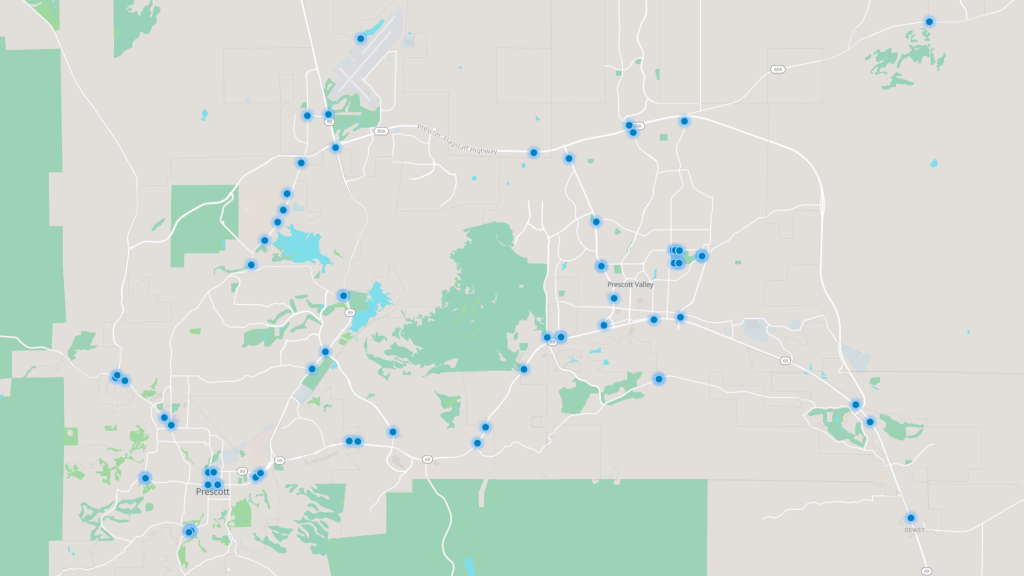
(Image of Prescott and Prescott Valley Flock camera locations as shown on DeFlock Maps Sept. 27, 2026)
Sourcing: Several details in this article, including the 2023 Prescott police emails and the disappearance of Prescott Valley’s Flock sharing-partner list, are sourced to reporting by Jen’s Two Cents, which reviewed public records obtained from the relevant cities.


Leave a Reply